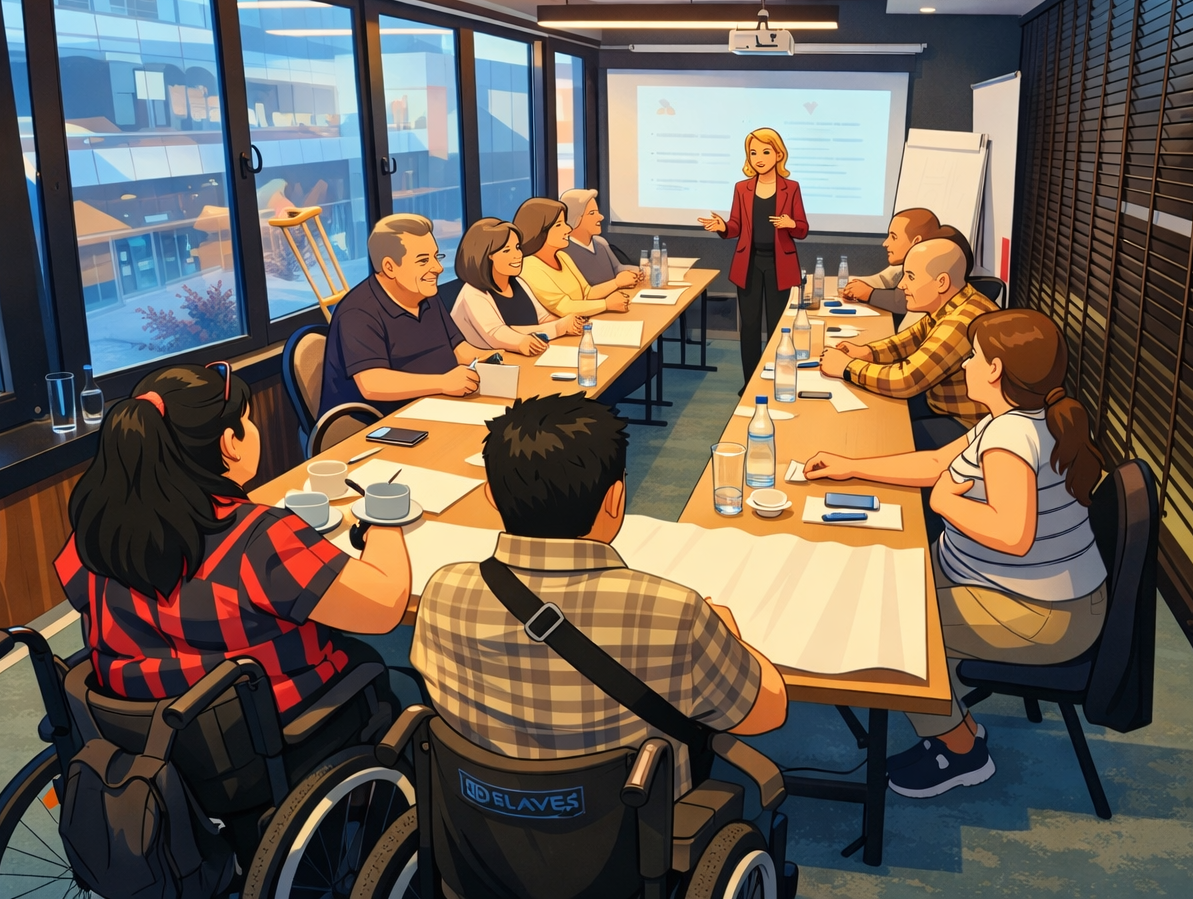
When election campaigns begin, politics often feels like a game reserved for the loudest voices. But in 2025, in towns like Strumica, Veles, Gostivar, and Kumanovo, something different began to unfold. For the first time, persons with disabilities were not only being spoken about in party programs, they were sitting at the table, shaping those very same programs.
This quiet, yet powerful change was driven by Inkluziva’s Empowerment Program, implemented under the Swiss Electoral Support Programme (ESP), with technical guidance from International Foundation for Electoral Systems – IFES. Between March and September 2025, the initiative worked with four political parties, SDSM, VMRO-DPMNE, Alliance for Albanians, and the ZNAM Movement, by bringing persons with disabilities into the heart of the decision-making in local politics.
From Listening to Leading. It all began with listening. Through needs assessments and consultations, Inkluziva identified the barriers that excluded people with disabilities from political life, the inaccessible offices, the lack of adapted materials, and most of all, the lack of awareness among party members about what inclusion truly means.
The program’s approach was both practical and empowering. Twenty participants, including eight persons with disabilities, received personal mentorship and tailored training. They learned how to advocate for their rights within party structures, prepare campaign messages, and even draft accessibility measures for their local branches.
For many, it was the first time they were treated as political actors rather than beneficiaries of goodwill. One participant from Strumica recalled:
“I realized I don’t need to wait for someone to speak for me — I can be the one proposing change.”
From Words to Action. Each participating party brought inclusion to life in its own way. In Strumica, the SDSM branch made inclusion a visible priority: two persons with disabilities were placed on the candidate list for municipal councilors, and one became a member of the Women’s Forum leadership. Campaign materials were printed in accessible formats and subtitled videos reached audiences previously excluded.
In Veles, VMRO-DPMNE’s branch integrated accessibility into urban planning. The “Panko Brashnarov” Primary School began redesigning its yard with inclusive play elements, while sensory rooms in primary schools became part of the city’s educational landscape. For the first time, a mayoral candidate publicly identified as a person with dyslexia, proving that inclusion has many faces.
In Gostivar, the Alliance for Albanians created an example of participatory policymaking. Persons with disabilities helped shape the party’s local election platform, ensuring that inclusive education, accessible sidewalks, and social services became municipal priorities.
And in Kumanovo, the ZNAM Movement took the message further. Their local election program imagined a “barrier-free city” – from tactile paths and sound signals to accessible buses, sports halls, and digital services. Their main campaign event was fully accessible, complete with a sign language interpreter, and their list included a young person with a disability who was already active in the party’s Youth Club leadership.
A Ripple Beyond the Program. The wave of inclusion reached even further than expected. Inspired by the program, several independent candidates and smaller parties began taking voluntary steps toward accessibility, producing subtitled videos, adding candidates with disabilities to their lists, and making public commitments to equality.
Among them was Goran Stojkovski – Diro, an independent mayoral candidate in Kumanovo, whose campaign featured a blind candidate highlighting real-life barriers to mobility in the city. These acts may seem small, but they symbolize something larger: an awakening of political awareness that disability inclusion is part of democratic credibility.
What Changed and What Comes Next. Change rarely happens overnight, but the signs are clear. Political branches became more aware, 2025 election programs were more inclusive, and individuals once seen as outsiders are now recognized as contributors.
Through mentorship, Inkluziva helped transform inclusion from an abstract ideal into a set of measurable, practical actions such as built ramps, campaign videos captioned, meetings accessible, and new spaces opened for dialogue.
The lessons are simple yet profound: when persons with disabilities are given the opportunity and tools to participate, political parties respond with openness. The inter-party workshop, where representatives from different political sides sat together discussing accessibility, proved that inclusion can also be a bridge across political divides.
Still, challenges remain. Not every party moved at the same pace, and resource constraints limited some participants’ engagement. But as one mentor from Inkluziva noted:
“The most important step has already happened, people now see inclusion as something possible, not optional.”
A Call to Continue the Momentum. The Empowerment Program showed that inclusion thrives where commitment meets opportunity. Its results should not remain one-time achievements but serve as foundations for the future.
Expanding mentorship, integrating disability inclusion into national party curricula, and ensuring continuous monitoring are key next steps. As the report concludes, the real success of this initiative lies not just in what was achieved in 2025, but in the shift of mindset it has sparked across the country’s political spectrum.
Inkluziva’s work proved that political participation by persons with disabilities is not a favor-it is a right, a democratic necessity, and a source of strength for society as a whole.
“Inclusion is not charity. It’s democracy in action.”
The story of the Empowerment Program is a reminder that every accessible ramp, every subtitled video, and every candidate list that includes a person with a disability tells the same story, one of a democracy that finally begins to look like the people it represents.
Author: Adapted from Inkluziva’s Final Report (2025) for Empowerment Program
Disclaimer: The Electoral Support Programme is a project of the Government of Switzerland implemented by the International Foundation for Electoral Systems (IFES). The content of this story can in no way be considered to reflect the views of the Government of Switzerland and IFES.